Justlend combines TRON lending, liquid staking, Energy Rental, and JST governance
Justlend lets users supply assets on TRON to earn variable interest and borrow assets against eligible collateral. Borrowing demand and available liquidity influence the rates that each lending market charges. Supply and Borrow Market (SBM) V1 combines interest-bearing supplies with collateral eligibility, while SBM V2 separates supply vaults from borrower collateral. The protocol also includes sTRX liquid staking, Energy Rental, and JST-based governance. These functions serve different purposes, so a lending yield, a borrowing cost, and a staking yield describe different relationships.
Last updated ·
Lending and staking have different sources of income
Borrower interest supports lending returns, while TRON voting rewards and resource rental revenue support sTRX staking returns. A supplier contributes assets that borrowers can access under the lending rules. A staker contributes TRX to the liquid-staking system, which manages voting and rents out staking-generated Energy. Energy Rental connects that resource supply with accounts that need TRON computing resources.
JST governance provides another connection: holders participate in decisions about the lending protocol. These decisions can change market configuration, including the parameters that determine how much collateral value supports borrowing.
SBM V1 supplies earn interest through jTokens
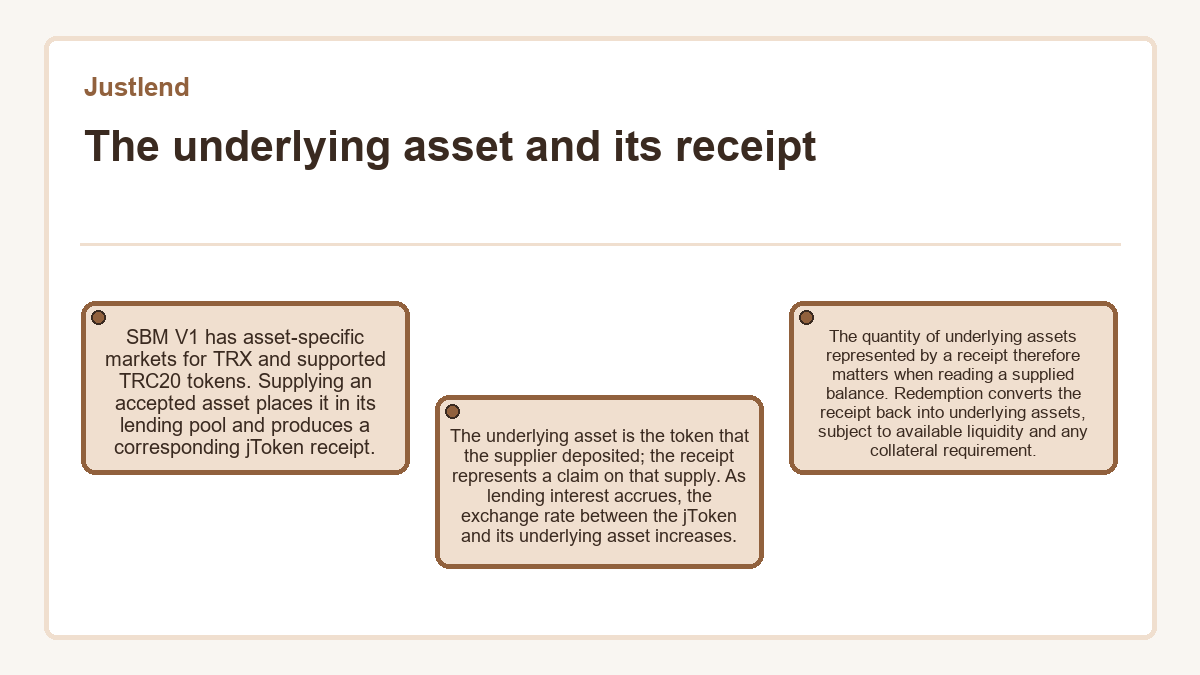
The underlying asset and its receipt
SBM V1 has asset-specific markets for TRX and supported TRC20 tokens. Supplying an accepted asset places it in its lending pool and produces a corresponding jToken receipt. The underlying asset is the token that the supplier deposited; the receipt represents a claim on that supply. As lending interest accrues, the exchange rate between the jToken and its underlying asset increases. The quantity of underlying assets represented by a receipt therefore matters when reading a supplied balance. Redemption converts the receipt back into underlying assets, subject to available liquidity and any collateral requirement.
Interest earnings and collateral eligibility
A supply can earn interest without automatically counting toward borrowing power. SBM V1 requires the account to enter the relevant market before its supplied asset counts as collateral. The market’s collateral factor then determines the eligible share of its value. This factor describes borrowing capacity, while the supply rate describes earnings. Confusing those measurements can lead to treating an interest-bearing balance as borrowing power that the account has not enabled.
SBM V2 vaults distribute liquidity to separate borrowing markets
Deposits enter a supply vault
SBM V2 accepts a single deposit asset into its corresponding supply vault. The vault allocates liquidity across underlying markets, and depositors receive returns that reflect their contributions to those markets. A vault’s supported collateral types describe what its borrowers can pledge. They do not mean that a supplier deposits every listed collateral asset. The deposited asset and the collateral behind its borrowers serve different roles.
Collateral belongs to a borrowing market
Each V2 borrowing market supports a particular collateral type and lends the asset supplied by its linked vault. Borrower collateral remains separate from the liquidity that suppliers provide, and it does not earn supply interest. Borrowing positions use market-specific risk parameters. This design separates the borrowing markets, while the supply vault connects their lending activity.
Why do lending rates change?
Lending rates change because market utilization changes, with SBM V2 also adapting its rate curve over time. Utilization measures borrowed assets relative to the liquidity supporting a market.
SBM V1 supports linear and kinked interest-rate models. A linear curve changes the borrow rate with utilization. A kinked curve applies a steeper slope above its configured utilization threshold. The model attached to the particular market determines the response; one curve does not describe every market. In V2, sustained utilization above or below the target can shift the curve itself, so the same utilization reading need not always imply the same borrowing rate.
In SBM V1, the per-block supply rate equals the per-block borrow rate multiplied by utilization and by (1 minus the reserve factor). The reserve factor sets the portion of interest that the protocol retains. A supplier’s rate therefore reflects both borrowing activity and the portion of interest available for distribution.
APY means annual percentage yield. It expresses an annualized rate rather than a fixed payment for the coming year. The rates that a position encounters over time determine its accrued interest.
Higher utilization can accompany a smaller available balance
Consider a hypothetical SBM V1 market where a reader wants to understand rising borrowing costs alongside falling liquidity. All token quantities below are hypothetical. The rate curve stays unchanged, and the example holds reserves constant while ignoring interest accrual during the comparison.
The market initially holds 8,172 token units in cash and records 11,376 borrowed units and 588 reserve units. V1 calculates utilization as borrows divided by cash plus borrows minus reserves. The denominator is 18,960 units, giving utilization of 60%.
An additional 1,896 units of borrowing changes cash to 6,276 units and borrows to 13,272 units. Reserves remain 588 units, so the denominator stays 18,960. Utilization reaches 70%. The borrowed balance rises by exactly the amount that the available cash falls.
On an upward-sloping rate curve, that change increases the borrowing rate while reducing the cash available for withdrawals. The exact rate increase requires the market’s configured curve. These utilization readings describe the pool; an individual account’s borrowing eligibility still depends on its collateral.
Borrowing capacity follows the collateral rules of each version
SBM V1 combines eligible collateral values
In V1, eligible supplied assets contribute borrowing power through their collateral factors and protocol prices. The Comptroller, the lending system’s risk-management contract, evaluates the account’s collateral and debt together. Its
getAccountLiquidity
function reports available borrowing capacity or a shortfall. A shortfall means that the account lacks sufficient eligible collateral under those rules. Available market cash alone cannot make that account eligible to borrow. Borrowing also adds an interest-bearing debt balance, which can reduce the remaining collateral margin as interest accrues.
SBM V2 applies a market’s LLTV
V2 uses the selected market’s liquidation loan-to-value, or LLTV, to define its liquidation boundary. Loan-to-value compares the value of the debt with the value of the pledged collateral. Each market sets its own LLTV, so a percentage shown for one collateral market does not establish a protocol-wide limit. The interface supports collateralizing alone, borrowing against sufficient existing collateral, or combining borrowing with collateralization. A combined operation does not remove the requirement that the resulting position satisfies the applicable risk rules.
Repayment reduces the debt behind the position
Repayment reduces outstanding borrowing and can create room to release collateral. The borrowed asset determines the debt’s unit, and accrued interest affects the balance due. V2 exposes repayment and collateral redemption separately or together in its interface. Redeeming collateral leaves the remaining debt subject to the market’s risk requirements.
Can supplied assets always be withdrawn immediately?
Supplied assets can be withdrawn only when sufficient underlying liquidity exists and the withdrawal satisfies any applicable collateral requirement. A supplied balance and an immediately withdrawable balance can therefore differ.
High borrowing utilization can leave a lending pool with limited available cash. Separately, a V1 account that uses its supplies as collateral must preserve enough borrowing power after redemption. These constraints arise from different parts of the system: pool liquidity concerns the assets available to return, and account collateral concerns the debt that remains. An interest-bearing receipt does not bypass either constraint. The proposed withdrawal amount must fit both before the account can redeem its supply.
sTRX represents a liquid-staking position on TRON
The sTRX system accepts TRX under TRON Stake 2.0 and issues sTRX at the applicable exchange rate. It manages Super Representative voting and reward claiming, and rents out the Energy generated by staking. Those activities produce voting rewards and Energy Rental revenue. The staking yield changes with both sources. This gives sTRX a different earnings basis from an asset supplied to a lending market, where borrower interest funds the supply return.
sTRX is a TRC20 token that represents the liquid-staking position. Protocol unstaking includes a waiting period before the holder can withdraw TRX. Holding a transferable staking receipt and completing protocol redemption have different timing.
Energy Rental supplies resources for TRON transactions
Energy Rental provides TRON Energy, a resource that smart-contract execution consumes. An order specifies the resource amount, rental duration, and receiving account. The service supports renting for the payer or for another regular account; it does not support contract addresses as recipients. Its cost depends on resource demand and the rental terms, rather than a lending market’s borrow APY. Energy Rental has its own payment and return rules, and staking-generated Energy contributes revenue to the sTRX system.
JST governance changes protocol configuration through proposals
JST holders govern the lending protocol through proposals and voting. For on-chain voting, they deposit JST to receive WJST voting tokens. GovernorBravo manages the governance process, and Timelock handles execution after the applicable delay. Discussion, voting, and execution represent distinct stages.
A proposal can affect the parameters that later lending activity uses. The V1 rate-model system routes model replacements through governance, while V2’s adaptive mechanism can adjust its curve without a new vote for each adjustment. Neither a governance proposal nor a token holding fixes the return that a lending or staking position will earn.
Collateral prices and contract behavior qualify the returns
Collateral-price movements can change borrowing capacity even when the quantity of supplied tokens stays the same. A decline in collateral value, an increase in debt value, or accrued borrowing interest can move a position toward liquidation. Once a V1 account has a collateral shortfall, the protocol permits a liquidator to repay part of its debt and receive collateral with an incentive. If collateral cannot cover the debt, liquidation can leave bad debt and losses for suppliers; market utilization measures how extensively borrowers use the pool’s liquidity.
Price oracles provide the valuations that lending rules use. Incorrect oracle data can distort collateral calculations. Smart-contract vulnerabilities can also affect supplied assets and available liquidity, so an attractive interest rate does not establish the security of the underlying contracts.
For account access, the interface supports TronLink and other supported wallets on TRON. Wallet authorization and the contract’s collateral evaluation serve different purposes: permission to interact does not establish borrowing capacity.
The next choice is the function that fits the intended use. Supplying provides lending liquidity, collateralization supports borrowing, and sTRX provides exposure to staking income. Energy Rental addresses transaction-resource needs.
What to know about Justlend
What does an “Insufficient spending cap” message mean?
The remaining token allowance is smaller than the amount that the transaction needs. A previous transaction may have consumed part of a custom spending cap. A new authorization must cover the intended amount, and it replaces the previous cap instead of adding to it. This allowance issue concerns permission to spend tokens, rather than the market’s borrowing limit.
How long does unstaking sTRX through Justlend take?
Protocol unstaking requires a 14-day wait before the unstaked TRX becomes available for withdrawal. The waiting period belongs to the unstaking process, so requesting unstaking and withdrawing TRX are separate actions. The holder can claim the completed unstaking amount after that period; a transferable sTRX balance does not remove the protocol’s waiting requirement.
Can someone else repay my SBM V1 debt?
SBM V1 supports repayment on behalf of another borrower through repayBorrowBehalf. The call identifies the borrower whose debt it reduces and the repayment amount. For a TRC20 lending market, the payer must grant the relevant token allowance. The repayment record distinguishes the account supplying the repayment funds from the borrower whose outstanding balance falls.
Does every borrowing action require two wallet signatures?
The borrowing interface does not impose one universal signature count. Increasing collateral can introduce an additional confirmation, and approval requirements can add further signing steps. The number depends on the selected action and existing permissions. These interface confirmations concern authorization; the underlying lending rules still determine whether the borrow is eligible.
Why does the app still show my old wallet address?
The app may still hold the previous connection or lack permission to access the newly selected address. If the wallet is disconnected, reconnect the current address. If the displayed address remains unchanged, refresh the app. Multiple active wallet extensions can also interfere with wallet selection, so disabling unused extensions can help resolve that conflict.
Is an Energy Rental prepayment the final rental cost?
An Energy Rental prepayment includes amounts that may later return to the payer. It covers the Energy Fee, Security Deposit, and Liquidation Penalty. Returning Energy early refunds the unused portion of the Energy Fee. The security-deposit refund depends on how much Energy has recovered. Returning before expiry refunds the liquidation-penalty deposit in full; an overdue order can be liquidated, forfeiting that deposit. The upfront payment therefore differs from the final retained cost.
When can risk-alert emails fail to arrive?
Risk-alert emails can fail to reach the inbox when mail filters block them, delivery fails, or the registered address is incorrect. Notifications can also arrive late or enter the junk folder. The relevant checks concern the mailbox settings and the address registered for alerts; an absent email does not establish that the borrowing position remains healthy.