Justlend energy rental uses TRX prepayments to fund Energy access and refundable reserves
Justlend energy rental supplies TRON Energy through a TRX prepayment that covers rent, a security deposit, and a liquidation reserve. Renting provides computing resources for contract transactions, including TRC20 USDT transfers. The upfront amount includes funds that may return when the rental ends. Actual rental time and resource recovery affect deductions, while timely return preserves the penalty reserve. The first rental requires an Energy estimate, a suitable rental duration, and an eligible account that will receive the resources.
Last updated ·
The payer, receiver, and rental contract have different jobs
The rental contract connects the supply of Energy with the account funding access and the account receiving resources. The payer funds the order in TRX. The receiver obtains delegated resources for its TRON transactions.
These accounts can be the same or different, allowing someone to fund a rental for another account. The contract records the allocation separately from the balance that pays for its use. Refunds belong to the payer, even when another account receives the Energy.
A first quote needs a transaction estimate and an eligible account
A rental quote relates an Energy quantity and rental duration to a receiving account before the payer commits funds. The planned contract operation determines the resource requirement. TRON also uses Bandwidth for transaction data, so rented Energy addresses only part of the network resource bill. The rental quote and the wallet’s transaction-cost estimate describe different charges.
The contract operation determines Energy demand
A USDT transfer can require different Energy amounts depending on whether its destination already holds USDT. Creating a fresh token balance involves additional contract work. The transfer destination affects that estimate; the rental receiving address identifies the account obtaining resources. Estimates for a USDT transfer do not establish the requirement for a lending operation or another contract call. The actual transaction estimate gives the relevant resource budget.
The receiving account must support delegation
The receiver must be an activated regular TRON account, and the rental contract excludes contract addresses. The interface allows the receiving-address field to remain empty when renting for the connected account. Renting for another account requires its receiving address. A newly generated address needs account activation before it can receive rented resources.
The prepayment combines rental time with refundable reserves
The initial TRX payment funds the selected rental period and holds reserves that cover resource recovery and possible liquidation. These components have different settlement rules. Refundable reserves can make the upfront TRX requirement larger than the rent ultimately charged.
The Energy fee covers rental time
The Energy fee follows the rented quantity, unit price, and duration. A longer funded period increases the time component when the other inputs stay unchanged. The interface prepays that component for the selected period. Rental prices vary, so the quantity and duration alone do not establish a fixed TRX cost.
The security deposit covers resource recovery
The security deposit corresponds to one day’s Energy fee for the rented quantity. It covers the recovery period after resource consumption. This reserve concerns the condition of the resources at return, while the time fee concerns how long the allocation remains rented. An unused time balance and a recovery deposit therefore need separate refund calculations.
The liquidation penalty reserves a liquidation reward
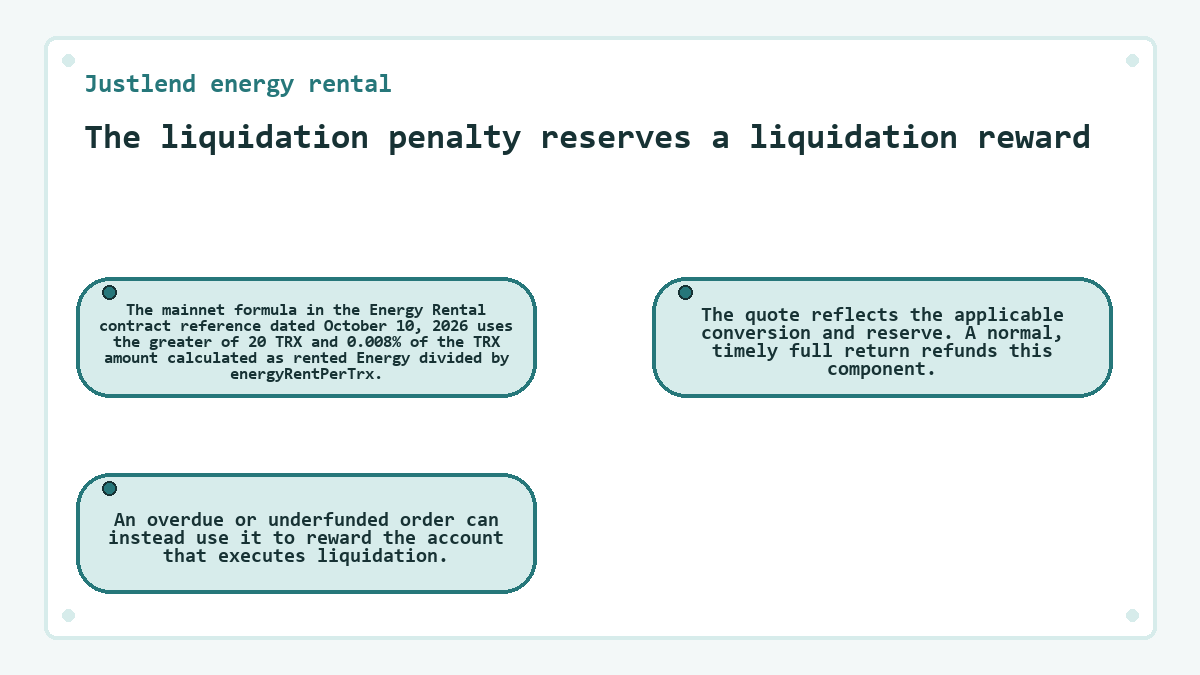
The mainnet formula in the Energy Rental contract reference dated October 10, 2026 uses the greater of 20 TRX and 0.008% of the TRX amount calculated as rented Energy divided by energyRentPerTrx. The quote reflects the applicable conversion and reserve. A normal, timely full return refunds this component. An overdue or underfunded order can instead use it to reward the account that executes liquidation.
What reduces the refund when Energy has been used?
Consumed Energy can reduce the security-deposit refund because the rental system charges for the recovery of resources returned before full restoration. The transfer can finish while its consumed Energy still affects rental settlement. The refund calculation therefore considers the resources’ recovery state alongside the order’s elapsed rental time.
Used Energy takes 24 hours to recover fully. A normal full return after full recovery refunds the entire recovery deposit. Returning while some resources remain consumed can create a deduction. During an active rental, recovered Energy becomes available for further contract transactions.
When all rented Energy remains consumed at return, the recovery charge equals 75% of the one-day security deposit. Partial consumption produces a proportional deduction. This calculation applies to the recovery deposit. It does not mean that the protocol retains three-quarters of every component in the original prepayment.
An early full return can also release the unspent Energy fee after the contract settles accrued rent. The refund can therefore include unused time charges while deducting a recovery charge. Keeping these amounts distinct explains how a successfully returned order can produce a refund smaller than the initial payment without a liquidation event.
Waiting for full resource recovery also prolongs rental time, so a larger deposit refund can accompany higher accrued rent.
Rate changes can shorten the remaining funded period
An order’s remaining usable time reflects its funded balance and rental rate, so its initial duration estimate need not remain fixed. Market rate movements can increase or decrease the remaining usable period. The received Energy quantity can also change slightly during the rental transaction. For rentals shorter than three hours, return the order immediately after the transaction to reduce exposure to early liquidation from rate changes. Remaining funded time determines when additional funding or return becomes necessary. A selected duration does not guarantee that the deposit will cover every later rate change.
Rental liquidation settles an underfunded resource order
An Energy rental becomes eligible for liquidation when its deposit no longer covers the order’s obligations. A liquidator can end the resource allocation and collect the liquidation reward. Settlement can return any remaining deposit to the payer. The funding condition establishes eligibility; a completed liquidation establishes that the allocation and balances have actually changed. The initial rental duration alone cannot show whether liquidation has occurred.
Failure to return an order before its funded period expires exposes the penalty reserve to forfeiture. Price changes can bring the funding problem forward. For liquidation, the contract smooths sharp price increases over six hours, so a spike does not take full effect immediately in that calculation. Monitoring this order concerns remaining rental time and deposit coverage. Justlend lending liquidation uses collateral and debt thresholds for a borrowing position. Those measures concern a different obligation from the prepaid resource rental.
How do you calculate the total TRX cost after return?
Total TRX cost equals the rental prepayment minus the actual refund, plus network charges for the relevant transactions. Those charges can include placing the rental, using resources, and returning the order. A full-return settlement supplies the actual refund figure. Comparing rental with burning TRX requires the same intended transaction and resource requirement. Historical dollar totals cannot establish a current saving because rental rates, network conditions, and the TRX exchange price can change.
Match the first rental to the transfer and its return plan
A first USDT transfer needs an appropriate Energy allocation and enough TRX to fund the rental’s complete prepayment. The Energy quantity describes resources available to the receiving account; the prepayment funds time and reserves. A low expected final charge can still require a larger wallet balance before the rental begins.
- Use the transaction estimate that matches the intended USDT transfer and its destination’s existing token balance.
- Select TRON Mainnet and confirm that the Energy receiver is an activated regular account.
- Review the Energy quantity, rental duration, and full TRX prepayment together.
- Include network charges and any resource-recovery deduction in the expected total cost.
- Plan to return the order or extend its funding before the remaining rental time runs out.
Before confirming payment, declining an unsuitable quote leaves the proposed rental unfunded. After a successful rental transaction, the active order shows the actual Energy allocation and remaining duration. Check that the received Energy covers the transfer estimate before sending USDT. Return the order immediately after the transfer succeeds. A completed full return ends the rental and settles the refundable balance. The settlement retains accrued rent and any recovery charge, even though the rental has ended.
Energy units differ from the TRX amounts behind the order
The interface displays an Energy quantity, while contract parameters describe the TRX quantity underlying the resource allocation and the payment funding access.
Delegated resource amounts
The contract’s resource amount represents delegated TRX in its smallest unit. Converting a desired Energy quantity requires the current Energy-per-TRX ratio. That ratio links the displayed resources to their staking basis; it does not turn the delegated quantity into the rental fee. A contract return amount uses the same delegated-resource basis. The contract rejects nonzero resource additions of 1 TRX or less. This minimum concerns delegated resources, separately from the rental payment.
Payment and duration units
One TRX equals 1,000,000 sun. Direct contract calls express TRX amounts in sun, while rental-time calculations use seconds. The payer’s payment funds the order separately from its delegated resource quantity. Reading both as the same amount would confuse resource capacity with the balance that covers rental charges.
Rental payments and sTRX staking returns follow different roles
The sTRX system stakes TRX under Stake 2.0 and rents out staking-generated Energy to produce rental income. It also manages Super Representative voting rewards. These income sources contribute to staking returns, which vary with voting rewards and rental activity. An Energy renter pays for access to those resources. Funding a rental does not by itself create an sTRX staking position or entitle the payer to staking rewards.
The same transaction type can have different rates or recovery deductions on another rental.
Practical questions about Justlend energy rental
Can one wallet fund Energy rentals for several receiving accounts?
The service supports one payer renting Energy for multiple receiving accounts. Each order associates the payer with its receiver and resource type, allowing separate allocations under the same paying account. The resources belong to the specified receiving accounts, rather than forming one shared Energy balance that every address can consume.
Who can return resources when the rental payer and receiver differ?
Both the payer and the receiving account have contract methods for returning the rental’s resources. The payer identifies the receiver, while the receiver identifies the original renter. These methods concern the same resource order. The refundable deposit belongs to the payer, even when the receiving account initiates the return.
Will a partial resource return release part of my TRX deposit?
The contract reports a zero deposit refund for a partial resource return. A partial return reduces the resource quantity remaining in the order. If the remaining deposit is insufficient, the contract forces a full return and sends any remaining deposit to the payer. A full return settles the refundable deposit, so reducing the allocation does not by itself establish that the payer has received TRX back from that order.
Does extending a rental require increasing its Energy allocation?
The rental contract supports adding funding without increasing the resource allocation. Its extension-only call uses a zero resource amount and a new TRX deposit. This extends the existing order’s funding coverage while retaining its resource quantity. The zero amount describes newly requested resources, rather than a zero rental payment.
How long can a single Energy Rental period be?
The interface supports a maximum single rental period of 30 days. It offers durations in hours or days. That maximum describes the selected period for one order; changing rental rates can still affect the actual remaining funded time. Extending an active order is a separate funding action.
Why can a stored deposit balance differ from the current rental balance?
A stored rental record can show the deposit at its last accounting update. The current-order query adjusts that value to current rental accounting. An integration assessing remaining coverage needs the updated balance, because an older stored amount can overstate the funds still available to support the resource allocation.
Do I need TRX for Energy Rental when my transfer balance is in USDT?
The payer needs TRX for the standard Energy Rental prepayment, even when the planned transfer uses USDT. A USDT balance supplies the tokens for the transfer; it does not fund the rental’s reserves or TRX charges. An account receiving Energy from someone else’s rental does not make that prepayment, but may still need TRX for network charges that rented Energy does not cover.